


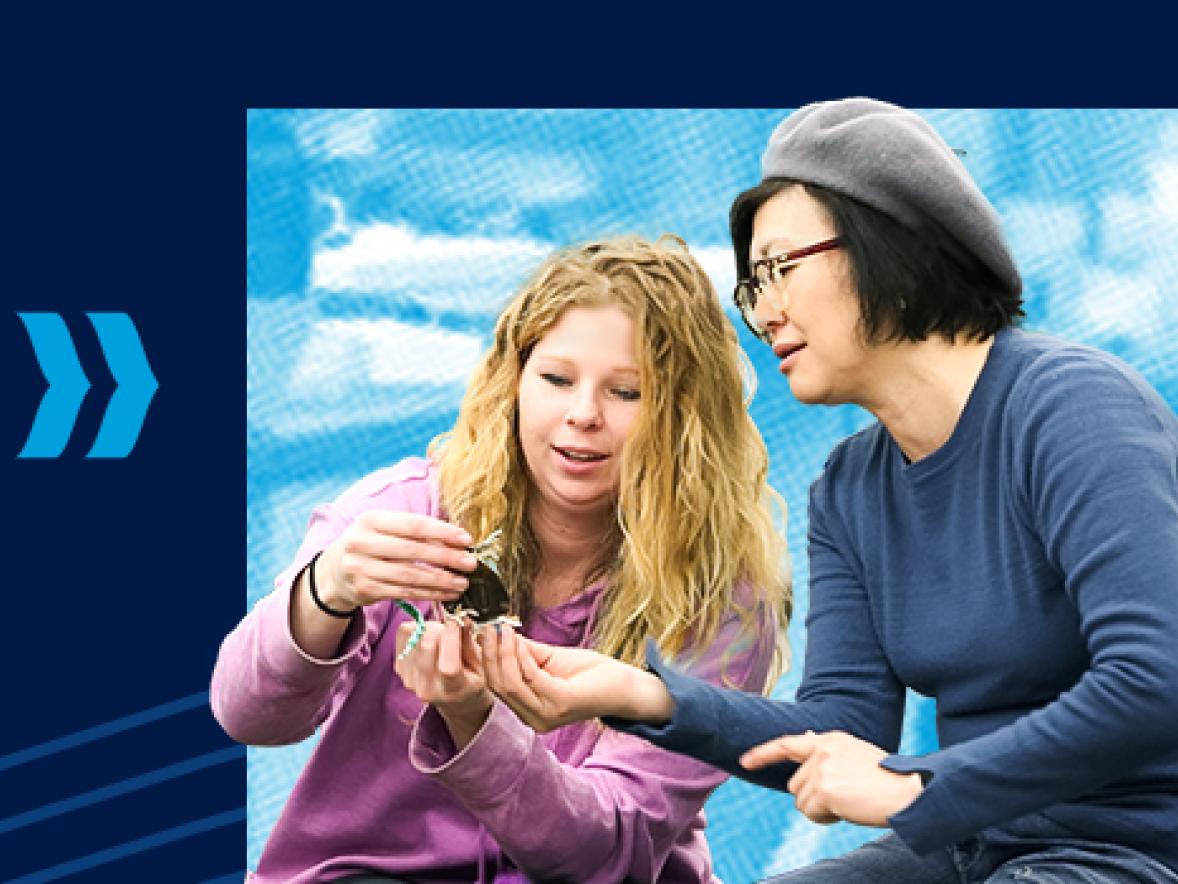

For student Brianna O鈥橞rien, it wasn鈥檛 just when class members hiked four miles up a mountain, guided by a naturalist, to breathtaking views of a double waterfall. Or when they swam in a tropical lagoon at night and witnessed bioluminescence 鈥� the water flashing blue from light given off by protozoans that surrounded them.
It was everything during the Jan. 5 to Jan. 16 trip to Belize with 12 classmates and two professors from University of Wisconsin-Stout that made it an impactful, life-changing experience.
鈥淭his experience was beyond beneficial for me personally and will be in my career,鈥� said O鈥橞rien, a senior from Spring Valley majoring in applied science with a concentration in biology.

Lindsay Penkala, an applied science-biology senior from Elburn, Ill., feels the same way. 鈥淭his was probably the best experience in my whole life.鈥�
Belize is in Central America, southeast of Mexico, on the Caribbean coast. The students, seven undergraduate and six from the Professional Science Master 黑料社区. in conservation biology, were in the Winterm course Natural History of the Neotropics.
鈥淏eing a biology student I wanted to put my knowledge that I鈥檝e gained at Stout into a real life experience, and this was the perfect opportunity to do so,鈥� O鈥橞rien said.
The trip was divided between three sites, each for about three days:

- Sittee Point and Hopkins in southern Belize. They saw several forests 鈥� lowland, coastal mangrove, tropical montane and bamboo 鈥� and visited Cockscomb Basin Jaguar Preserve.
- Isla Zafiro Marine Station, a roughly one-acre island two miles offshore. They also went to the barrier reef 鈥� the second largest in the world 鈥� another several miles into the ocean.
- San Ignacio in western Belize. Day trips were taken to the ancient Mayan ruins at Caracol, a historic Mayan ceremonial cave, and the Belize Zoo.
鈥淲e champion experiential learning at Stout, and this may be the epitome of that,鈥� Professor Mike Bessert said. 鈥淚 love all my courses, but this is one of my favorites because it 黑料社区. high impact in so many ways.鈥�
Science on the edge
Two weeks of classes were held before the trip. Once in Belize, students had to be mentally and physically prepared.
鈥淵ou have to be adventurous and willing to maybe endure some extreme conditions at times. Students come in knowing that,鈥� Bessert said. 鈥淢ost years we spend a little time discussing what fears or challenges they want to overcome, like water, heights, an animal or maybe spiders. We鈥檝e never had a student not overcome something. Gaining self-confidence is a huge part of the experience.鈥�

They snorkeled in the barrier reef with sharks and rays nearby, for example.
鈥淚 had to overcome a lot of obstacles that I wouldn鈥檛 necessarily be faced with in the U.S. Taking those challenges head on had an impact on me and made me take a step out of my comfort zone,鈥� O鈥橞rien said.
Taking the course is 鈥渁n uncomfortable leap of faith, but the payoff is incredible,鈥� she added.
Penkala loved spelunking in the Mayan cave and learning about its grim history. 鈥淚t felt almost like we were transported back into the past and were exploring in the time of the Mayans,鈥� she said.
The cave helped reinforce what the class was about. Collapse of the local Mayan civilization beginning around 900 A.D. was caused mostly by deforestation, resulting in lack of rain and eventually human sacrifices at the cave in an attempt to bring rain, Bessert said.
鈥淭oo often we don鈥檛 learn from history,鈥� Bessert said. 鈥淭he predominant focus of the class is natural systems and their underlying dynamics. How are biodiverse hotspots maintained and how do we preserve them?鈥�
Science mixed with culture
They also experienced the country 黑料社区. cross-section of three main cultural groups, Creole, Garifuna and Mayan.
Penkala took the course because of her interest in animal and ecosystem conservation, but she learned so much more.
鈥淒r. Bessert assured us that we would meet many different cultures in Belize and we sure did. It was amazing to see how their attitude, food and even architecture differed from ours. It was also very interesting to learn the local opinions on conservation and preserving wildlife,鈥� Penkala said.

鈥淭raveling out of the country really helped me realize how grateful I should be for the things I have. Just as an example, Belizean farmers can sell 100 pounds of oranges to an American company for one Belizean dollar, equal to 50 cents in the U.S. I never would have known it was that bad unless I went down and talked to the locals. So, if anything else, I would say that Belize humbled me,鈥� she said.
The learning that takes place beyond science is one of the goals of the course.
鈥淵ou can鈥檛 go to Belize without immersing yourself in the human culture there,鈥� said Bessert, who has led the course for 10 years. 鈥淪tudents are required to talk with people and get to know them and the customs.鈥�
Evan Croft, of Stanley, who will graduate in May with his master 黑料社区., said he advanced his knowledge of science while achieving several life goals with the trip, and as a result added more. But what he鈥檒l remember most is the people.
鈥淲e were just a group of students, and they cared for us and guided us like family they have known for years. We had a Garifuna drum circle come and perform for us. I had the opportunity to be taught a dance to one song and to play the driving bass line of another song during their performance,鈥� Croft said.
鈥淭he first song that they sang and played for us was a tribute to their ancestors, and the lyrics roughly meant 鈥榳e are here with our friends and family, we are happy and celebrating together, by the ocean.鈥� They were so quick to have us share in this important aspect of their culture, and the experiences like this made the entire trip worthwhile,鈥� he said.
鈥榊ou see so many amazing things鈥�
The Office of International Education coordinated the study abroad course and helped Bessert develop a COVID safety plan for the trip, including testing before leaving and prearranging for a testing service in Belize.
Except for 2021 because of COVID, the trip has been held every Winterm since 2012.

Students paid a special program fee that included tuition and fees and travel expenses. The course meets university requirements for global perspectives and natural sciences.
鈥淵ou see so many amazing things you never see elsewhere,鈥� Bessert said. 鈥淚 design the course in a way where they have different 鈥榳ow鈥� moments. It really gives them a great appreciation for the biodiversity that 黑料社区. there.鈥�
For example, they used trail cameras and captured an unexpected image of a jaguar passing through.
Joining Bessert as a co-host this year was biology Professor Steve Nold, who is impressed with the country 黑料社区. ability to balance tourism while maintaining its diverse biodiversity.
鈥淭his course offered so much more than an academic treatment of the plants and animals in Belize. Students were introduced to many cultures and met extraordinary people. We learned kindness and humility from our hosts and tour guides. We overcame personal challenges and better understood how societal decisions can greatly impact environmental quality. In short, this was an unforgettable life experience,鈥� Nold said.
Bessert first went to Belize nearly 30 years ago as an undergraduate and graduate student and has maintained connections with guides and others over the years.
鈥淚f I would have traveled to Belize with any old vacation company, there 黑料社区. no way I would have learned half the information I did with Dr. Bessert 黑料社区. friends,鈥� Penkala said.
###


